

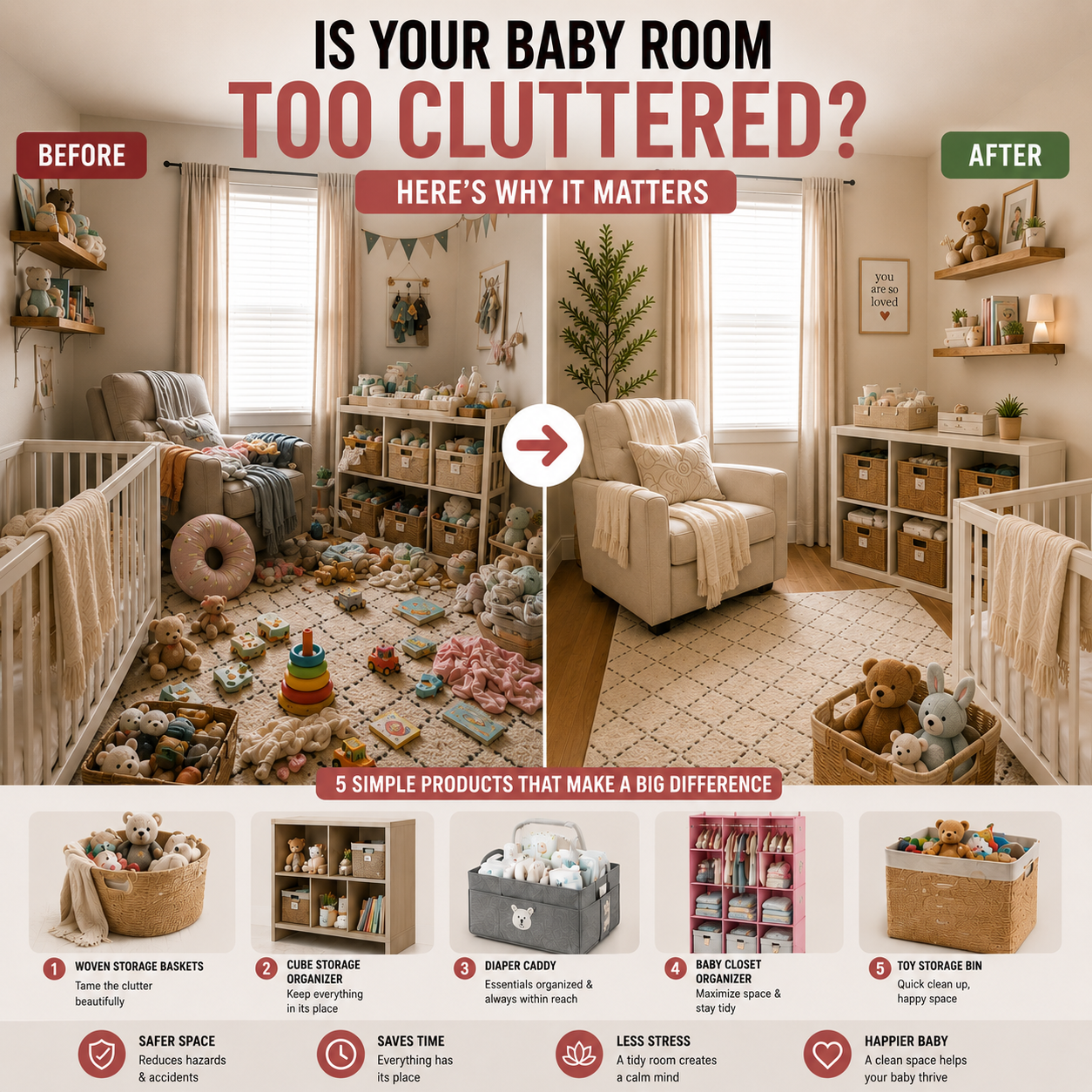
A cluttered nursery can become difficult to manage surprisingly fast. These baby room organization ideas show how dedicated storage for toys, clothes, diapers, books, and blankets can create a calmer and more functional space.
This baby room organization concept shows how giving everyday items a dedicated home can create a calmer, more functional space without removing the things your baby actually needs.
Affiliate disclosure: This article may contain affiliate links. If you purchase through one of these links, NookShift may earn a commission at no additional cost to you. We only feature products that are relevant to the makeover concept and our readers.
Table of Contents
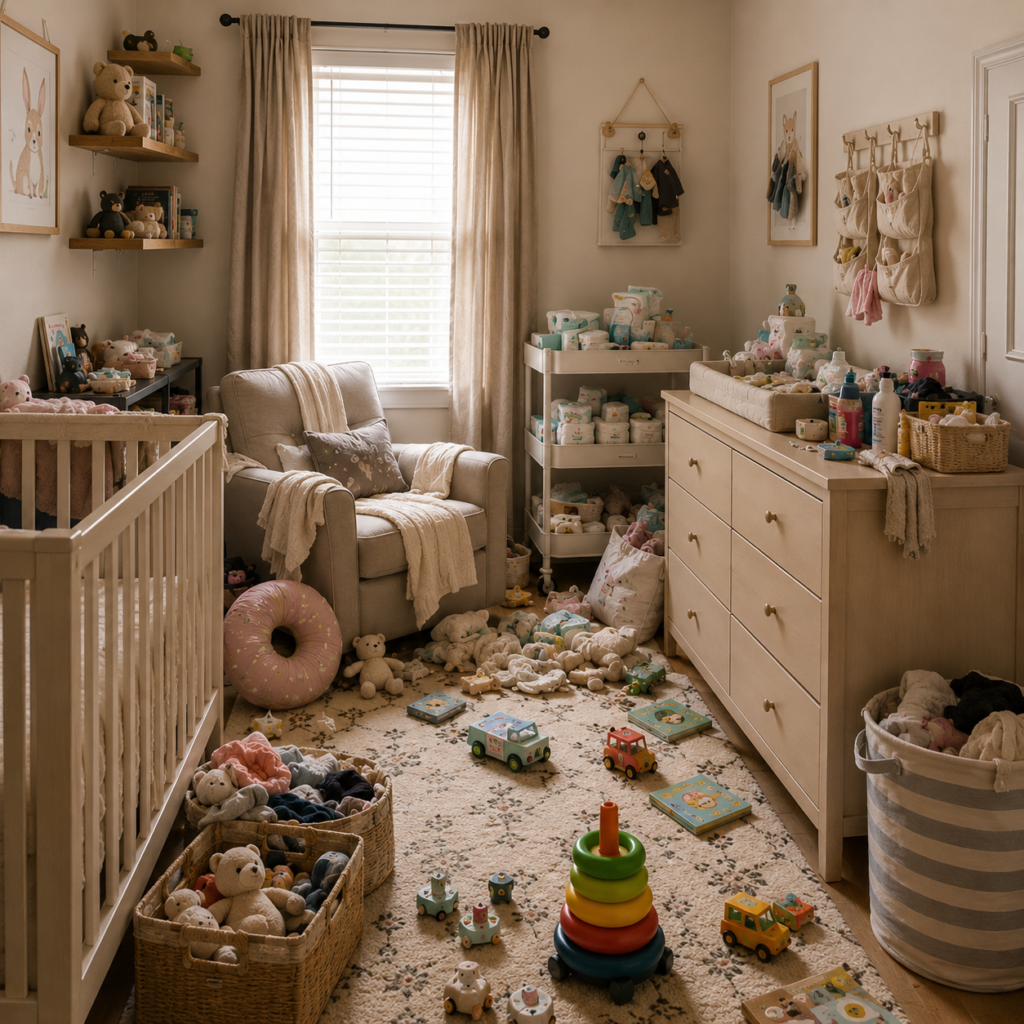
When a nursery becomes cluttered, the problem isn’t necessarily that there are too many belongings. Often, it’s that toys, clothing, books, diaper supplies, and blankets don’t have clearly defined storage zones.
In the before view, toys and soft items spread across the floor, baskets are overflowing, and several storage areas are competing for attention. The room has useful furniture, but much of the available storage isn’t organized around simple everyday routines.
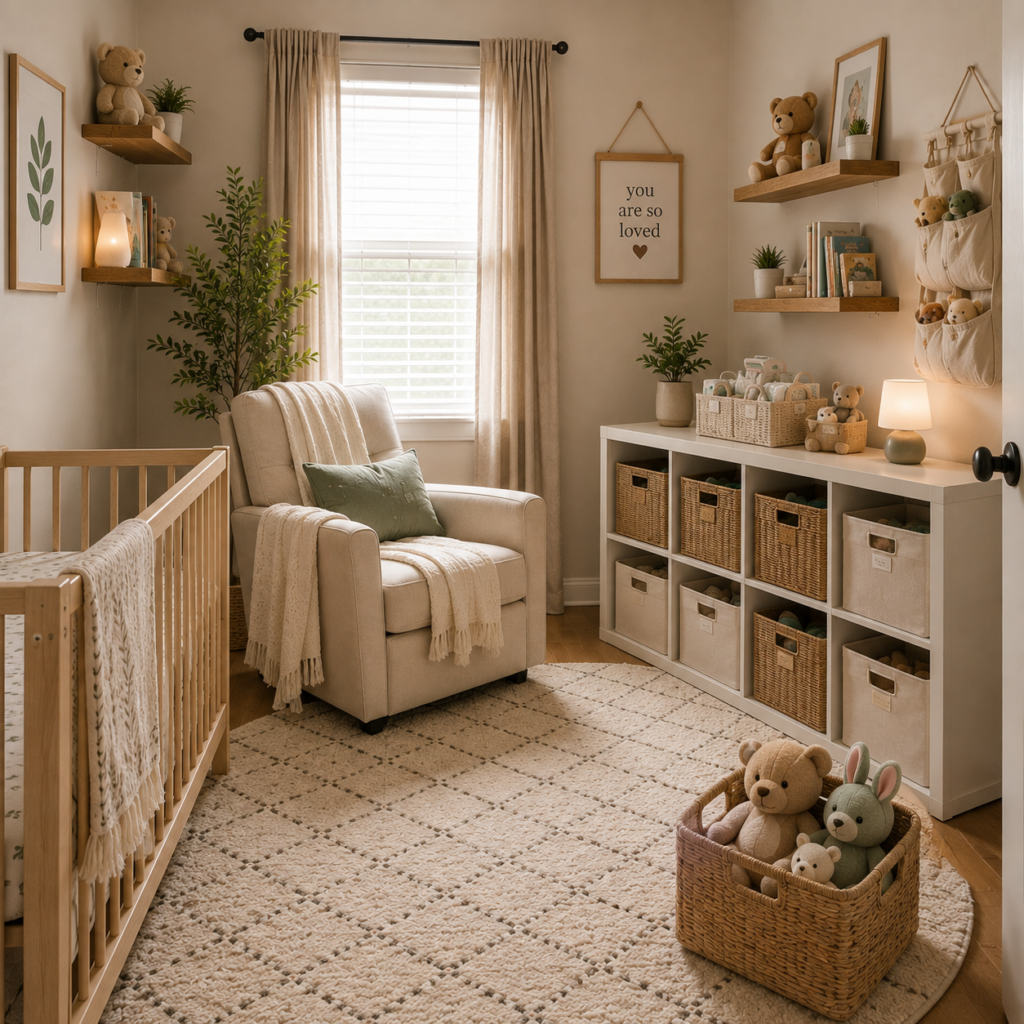
The redesigned concept takes a different approach: keep the floor clearer, use open storage for frequently accessed items, hide visual clutter in baskets, and create separate zones for clothes, toys, books, and diaper essentials.
The same principles can work beyond the nursery. If you’re dealing with limited square footage elsewhere, these small bedroom storage ideas and space-saving ideas for a small living room offer additional ways to make compact rooms work harder.
1. Baby Room Organization: Why the Original Space Wasn’t Working
A nursery needs to handle a lot of different activities in one relatively small area. Sleeping, dressing, diaper changes, playtime, reading, and storing extra supplies may all happen in the same room.
That makes organization especially important.
Floor clutter reduces usable space
The biggest issue visible in the before image is the amount of floor space occupied by toys, baskets, books, and other small items.
Even when each object is useful, spreading those items across the room reduces the clear area available for moving around and makes the nursery appear more crowded.
The redesigned concept moves many of these belongings into dedicated storage zones while leaving the center of the room much more open.
Too many items are competing for attention
Open storage can be practical, but when every shelf, basket, and surface displays something different, the room can start to feel visually busy.
A useful solution is to combine open and concealed storage. Keep frequently used or easy-to-sort items accessible, while baskets and bins contain smaller objects that would otherwise create visual clutter.
Baby essentials need predictable homes
A nursery is easier to maintain when categories stay together.
Instead of mixing books, clothes, toys, diapers, and blankets across several areas, the makeover concept assigns them specific locations. This makes the organization system easier to understand at a glance and easier to reset after a busy day.
2. The Baby Room Organization Plan
The transformation isn’t about filling the nursery with more furniture. It’s about making each storage piece perform a specific job.
Create clear storage zones
The redesigned room uses separate zones for different categories.
A low cube organizer provides shelving and basket storage. A dedicated toy organizer keeps small toys separated into bins. The tall wardrobe-style organizer consolidates clothing and folded items. Large woven baskets provide flexible storage near floor level.
This approach reduces the need to search through unrelated items every time something is needed.
Use vertical space without overwhelming the room
One of the strongest differences between the two views is how storage is concentrated around the perimeter rather than scattered across the floor.
The taller organizer provides storage upward, while the low units maintain a more open visual line across the center of the room.
For compact nurseries, that balance can be useful: vertical storage increases capacity, while lower furniture can help prevent every wall from feeling crowded.
Keep the center of the nursery open
In the after concept, the rug and central floor area are largely unobstructed.
Rather than allowing baskets and loose toys to migrate across the room, the design gives them defined places along the walls and inside larger storage baskets.
That simple change makes the overall layout look calmer and more intentional.
3. How the Transformation Improves the Room
The biggest visual difference is not a dramatic decorating change. It’s organization.
The crib remains positioned along one side of the room, storage remains around the perimeter, and the overall nursery palette stays soft and warm. What changes is how the belongings are contained.
The before view shows several overlapping storage problems: loose toys on the rug, overflowing containers, crowded shelving, and clothing and soft goods distributed across multiple areas.
In the proposed after concept, those same categories are consolidated.
Books have a dedicated shelf area. Smaller toys go into divided bins. Folded clothing is grouped together. Larger soft toys can be dropped into open woven baskets. Diaper supplies can stay together in a portable caddy.
This demonstrates an important small-space principle: you don’t always need more room—you often need clearer categories.
A well-organized nursery can also be easier to maintain because putting something away requires fewer decisions. Instead of asking, “Where can this fit?” each item already has a general destination.
4. Products Used in This Baby Room Organization Concept
The products below correspond to the storage solutions featured in the makeover concept. Before purchasing any nursery furniture or organizer, measure your available space, verify the current product specifications, and consider how the item will fit around doors, windows, walkways, and existing furniture.
Furinno LUDER Book Shelf, 5-Cube Bookshelf
A compact cube unit works well in this concept because it creates several storage zones without requiring a large piece of furniture.
The Furinno LUDER Book Shelf, 5-Cube Bookshelf, Reversible Bookcase, 9.4 x 19.5 x 31.5, Easy Assembly, for Living Room, Bedroom, Home Office, White is listed at $39 based on the information supplied for this article.
In the makeover, this type of organizer helps bring books, baskets, and smaller nursery items together in one defined area instead of allowing them to spread around the room.
Because the supplied dimensions are 9.4 x 19.5 x 31.5, compare those measurements carefully with your available wall and floor space.
See the exact 5-cube bookshelf used in the concept.
StorageWorks Pantry Baskets for Organizing
Baskets are particularly useful when open shelving starts to look visually crowded.
The StorageWorks Pantry Baskets for Organizing, Wicker Basket with Built-in Handles, Handwoven Wicker Storage Baskets, Water Hyacinth for Shelves, 2 Pack is listed at $37.
In this concept, woven baskets help turn open cubbies into more contained storage. They can visually simplify the shelving by grouping smaller belongings rather than leaving everything exposed.
Before ordering, check the current basket dimensions against the inside dimensions of the shelf or cubby where you plan to use them.
View the StorageWorks woven storage baskets.
Parker Baby Co. Felt Diaper Caddy Organizer
Diaper supplies are easier to manage when they stay together instead of being distributed across several shelves.
The Parker Baby Co. Felt Diaper Caddy Organizer – Regular, White is a portable nursery storage bin designed to sort diapers, wipes, bottles, and baby essentials. The supplied information describes a soft felt, foldable design measuring 13 x 9 x 7 inches, with a listed price of $19.
Its role in the concept is straightforward: create one portable home for frequently used baby-care supplies.
See the Parker Baby Co. Felt Diaper Caddy Organizer.
Baby Closet Organizer for Nursery
Baby clothing may be small, but multiple sizes, outfits, blankets, and folded pieces can quickly make a nursery look crowded.
The Baby Closet Organizer for Nursery – Durable Baby Wardrobe Armoire for Closet – Customizable Dresser Shelves – Waterproof Shelf Clothes Organizer w/Wall Fixation is listed at $59.
In the makeover concept, the tall organizer creates a dedicated clothing zone along the wall. Hanging pieces and folded items can be grouped vertically rather than taking up storage in several different areas of the nursery.
Because this is a taller storage solution and the supplied product description references wall fixation, check the current product instructions and your wall or lease requirements before setting it up.
See the baby closet organizer used in the concept.
JMvicyroam 60L Cotton Rope Laundry Basket Hamper
Some nursery items don’t fit neatly into small cubbies. Stuffed animals, toys, blankets, and other soft items often need flexible, easy-access storage.
The JMvicyroam 60L Cotton Rope Laundry Basket Hamper, Brown is listed at $18. The supplied product information describes it as collapsible, freestanding, machine washable, and equipped with reinforced handles, with capacity for 3–5 thick blankets, clothes, or toys.
In the concept, large floor baskets provide a simple place to gather bulky toys instead of leaving them spread across the rug.
View the JMvicyroam 60L cotton rope basket.
Toy Storage Organizer with Bookshelf for Kids
Small toys create a different organization problem: they need to remain accessible without becoming one large mixed pile.
The Toy Storage Organizer with Bookshelf for Kids, Large Wooden Shelf with 12 Storage Bins & 6 Shelves, Toy Box Organization for Kids Rooms, Playroom, Nursery and Living Room is listed at $99.
The divided-bin design shown in the makeover gives smaller toys defined compartments while keeping them accessible from the front. The additional shelving also creates a place for books and other nursery items.
This is one of the larger storage pieces in the concept, so measure the intended location and verify the current product dimensions before purchasing.
See the toy storage organizer with bins and shelves.
5. How to Recreate This Organized Baby Room
You don’t need to copy every element of the concept to make a cluttered nursery easier to use.
Start by removing everything that currently lives on the floor without a permanent home. Sort those belongings into a few broad categories such as toys, books, diaper supplies, clothes, blankets, and items that belong elsewhere.
Next, decide which categories need quick access.
Frequently used items may work better in open bins or a portable caddy. Items that create visual clutter can go into baskets. Clothing benefits from a dedicated wardrobe or shelving zone, while books and small toys can be grouped into low organizers.
Then measure before adding storage. Pay particular attention to door swings, windows, the crib area, and walking paths. A storage unit only solves a space problem if it fits without creating another one.
If you rent, check your lease before making wall attachments or other changes. Follow the manufacturer’s current assembly, placement, and anchoring instructions for any furniture you use.
Finally, resist the temptation to fill every new shelf immediately. A little empty space makes an organization system easier to maintain and gives the nursery room to adapt as your baby’s needs change.
Frequently Asked Questions
How can I make a cluttered baby room feel more organized?
Start by reducing floor clutter and grouping belongings by category. Give toys, books, clothes, diaper supplies, and blankets separate storage zones instead of spreading them across several surfaces.
Which storage product should I prioritize first?
Focus on the category creating the biggest problem in your nursery. If toys dominate the floor, a divided toy organizer or large basket may have the greatest impact. If clothing is the issue, dedicated wardrobe storage may make more sense.
Is this baby room organization concept renter-friendly?
Many of the ideas rely on freestanding baskets, shelving, and organizers. However, always check your lease and the manufacturer’s instructions, particularly when a product requires or recommends wall fixation or anchoring.
What should I measure before buying nursery storage?
Measure the available floor and wall area as well as nearby doors, windows, furniture, and walking paths. You should also compare your measurements with the current dimensions of each product before ordering.
Can I organize a nursery without buying every product shown?
Yes. The main idea is to create dedicated storage categories. You can adapt the concept to the furniture and organizers you already own and add only the storage that solves a specific problem.
Final Thoughts
A cluttered baby room doesn’t necessarily need a complete redesign. Sometimes the most useful change is simply giving everything a clearer place to go.
This baby room organization concept uses cube storage, baskets, a diaper caddy, dedicated clothing storage, and divided toy bins to move belongings away from the center of the room and into defined zones. The result is a nursery that looks calmer, keeps more of the floor visible, and makes everyday storage easier to understand.
Before choosing any organizer, measure carefully and think about the specific type of clutter you’re trying to solve. You can explore the exact products featured above or continue with these small bedroom storage ideas for more ways to organize limited space.